How Local Businesses Can Win State and Local Contracts

On Monday, May 4, as part of a series of events to celebrate Small Business Week, I attended Franklin County’s “Beyond the Basics Workshop: Get Secure. Get Certified. Get Contracts.” in Youngsville, where local staff from Franklin County broke down what it takes to win government contracts and do business with the State of North Carolina and Franklin County government. Here are the highlights:
- The State of North Carolina is one of the largest buyers in the region, consisting of:
- 28 State Agencies
- 16 Public Universities + 58 Community Colleges
- 2,500+ Public Schools
- 100 Counties + 500+ Municipalities
- The first step to being considered for a state contract is to register with the Electronic Vendor Portal (eVP). This is also where you can see open requests for proposals.
- At the state level, the process for securing a contract depends on the value of the contract. The higher the amount, the more structured and competitive the process is. This looks like:
- Under $10,000
- Micro purchase (P-card)
- $10K–$30K
- Informal quotes
- $30K–$100K
- Competitive quotes required
- $100K+
- Formal bidding (RFP/IFB)
- Under $10,000
Counties and municipalities also purchase goods and services directly from local businesses. If you have a product or service, there is likely a government buyer.
Locally in Franklin County:
- Franklin County wants to work with local businesses.
- If you want to be considered for a contract, the best thing to do is get to know the people making these decisions. A great place to start is reaching out to the folks at the Franklin County Economic Development Office.
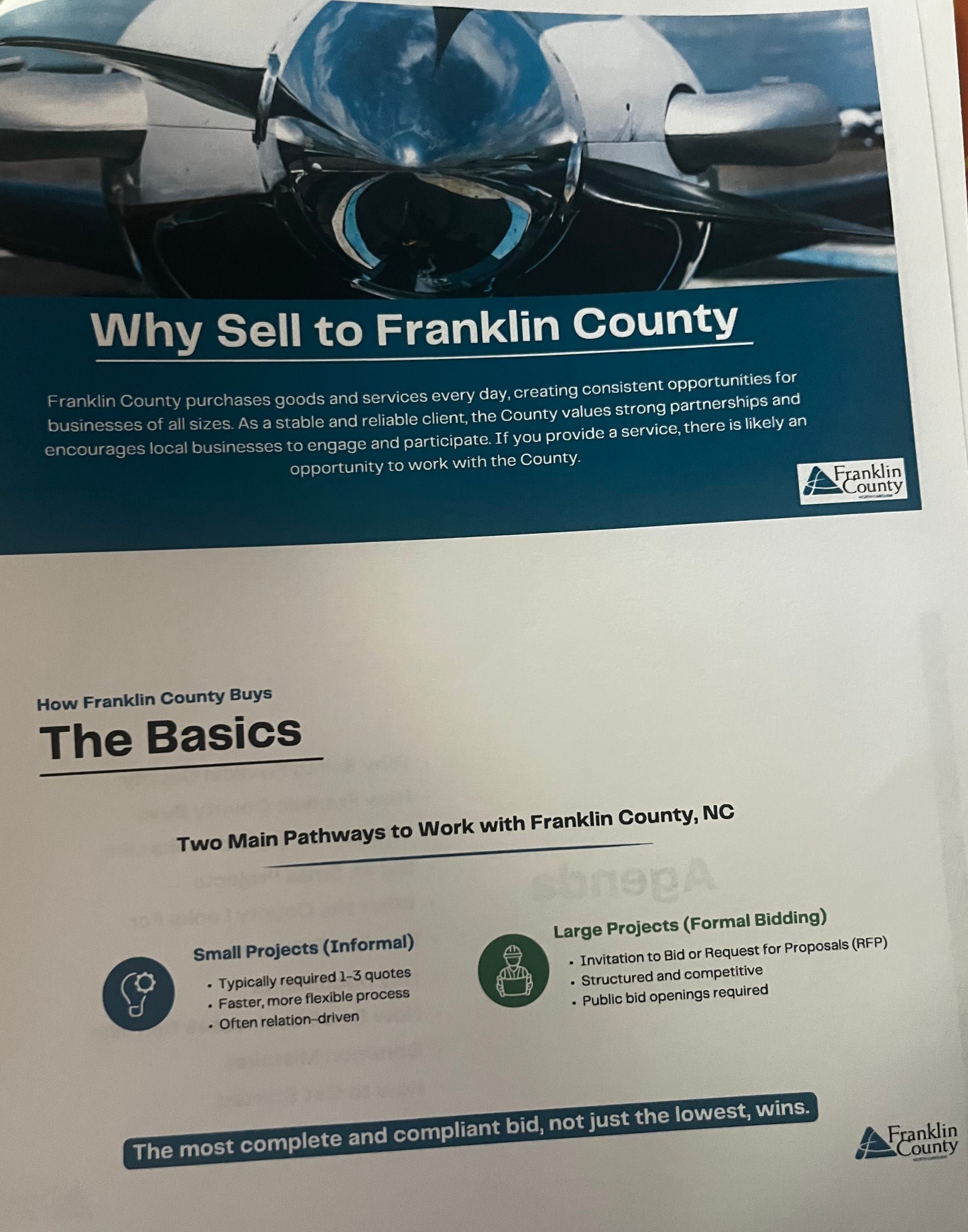
- For smaller contracts, the county will usually get 1-3 quotes and make a decision based on referrals, experience and an online search.
- Larger projects require a more robust process, including a formal, public and competitive bidding process.
- Payment is reimbursement-based, so businesses must be able to cover the cost of the project up front.
- When deciding on a contract, the county is looking for: responsive communication, reliability (meeting deadlines), competitive, transparent pricing, the ability to meet all requirements, willingness to follow county processes, an understanding of local government, the ability to manage reimbursement payments and proper licensing & insurance.
Tips for successfully bidding on work with state and local governments:
- Make sure your paperwork is in order. This usually includes:
- Business registration
- W-9 form
- Licenses (if required)
- Proof of insurance
- You may also need to provide:
- Proof of citizenship/residency
- Proof of ethnicity (if applying for HUB, which stands for Historically Underutilized Businesses. These are usually minority-owned, women-owned, veteran-owned and/or Small businesses.
- Ownership documentation
- Bank verification
- Salary structure
- Equipment list (owned or leased)
- Lease agreements
- References (2+)
- Past performance examples
- Licenses (if required)
- Proof of insurance
Getting Started (Action Steps)
- Register in eVP
- Prepare documents early
- Consider HUB certification
- Build connections
- Make your business visible (website matters)
State and local government are a great opportunity for small businesses to secure consistent, reliable work. The most important things you can do to set your business up for success are to make sure you understand the process, have all the necessary documentation in order and develop relationships with local decision-makers. Making your business visible through a good website and registering with the state’s Electronic Vendor Portal will put you ahead of the competition. Now, go get’em!